5e Potions and Potion Making:
a guide on how to make potion making complicated and fun.

TLDR: Potion Craft Roll = D20 + Relevant Skill Modifier + Proficiency + Alchemy/Herbalism Kit + Item Ingredient bonuses
Immediate Clarification: A DM designs a potion; a character makes a potion.
- Potion Making: the act of making a potion in world, as one would make a sandwich or a sculpture. This action is typically performed by characters within a campaign.
- Potion Designing: The act of deciding a potion’s abilities, stats, and ingredients. This action is typically performed in narrative creation outside of the campaign.
Introduction
Whether in the heat of battle or in the heart of a snowstorm, potions are essential to surviving in the realm of magic and fantasy. However, in regard to crafting potions, I have found the systems in place for 5e to be lacking. This simple guide will allow any new player or veteran DM to craft custom potions in a way that is easy and understandable.
Ingredients
First things first are the ingredients. As a DM it is important to know what kind of campaign you are running. In my experience, players often hold onto their ingredients and items for so long that what was once freshly squeezed milk from the best cow in the land, has now become a disgusting white brick of discarded curds that not even the flies would touch. So, how can you make the many Items gained through adventures usable in potion creation? Well, this can be subverted by making nonspecific potion ingredients.
In my campaigns I often operate under the assumption that the adventurers have all items on their person that would make travelling easier. Rather than forcing them to track every morsel of food on their person I have found it easier to assume that the players gather their candles, their matches, their daggers, and their rope at the local ports. This also Applies to spell and potion components/ingredients. Unless the player makes/finds a specific ingredient for a potion that they are looking for, it can be assumed that they have all the ingredients they need to make a base level potion; however, this means that they will not gain any bonuses for having unstated ingredients, it is just assumed that they have the name brand worst quality of that ingredient available.
Nonspecific Tags
Take a potion of healing for instance. When designing the ingredient requirements for the potion, one might think to say, “Blue Mountain Flower and Wheat, or Blisterwort and Wheat“ (i.e. Elder Scrolls), but rather than that you could say:
o “A thing made with love
o A thing of life and faith.
o The name of an old companion, no longer with us.
These nonspecific tags make the potions more accessible to be made and have the potential to provide an in-depth mechanic for roleplaying. Example:
Potion of Healing Requirements: A thing made with love and A thing of life and faith. The name of an old companion, no longer with us.”
Most things that were once alive fit the requirement of “being made with love”
Holy water works perfectly for “A Thing of Life and Faith”
And as for the “old companion” it doesn’t require the companion to be dead, just no longer around, and as for adding the name, parchment or carved wood should do just fine.
Ingredient ratings
Ingredients should also be filtered by their importance to the world and/or their importance to the player, where the more important ingredients make the potion easier to make. I can understand the desire to assume that using stronger ingredients would contribute to making a stronger potion, but I would push back against that as the player should determine the potion they want to make first and then use the ingredients required to achieve that goal. For instance:
- The horn of an extinct race of unicorn might be insanely valuable and therefore give a +5 to a potion making roll, but also, A PC’s (Player Character) mothers bracelet that they have held throughout the campaign and have referenced in every roleplaying moment may have just as much value and would in my opinion also be a +5.
When deciding the value of an ingredient to the narrative vs the value of a potion to the world, you can ask these questions:
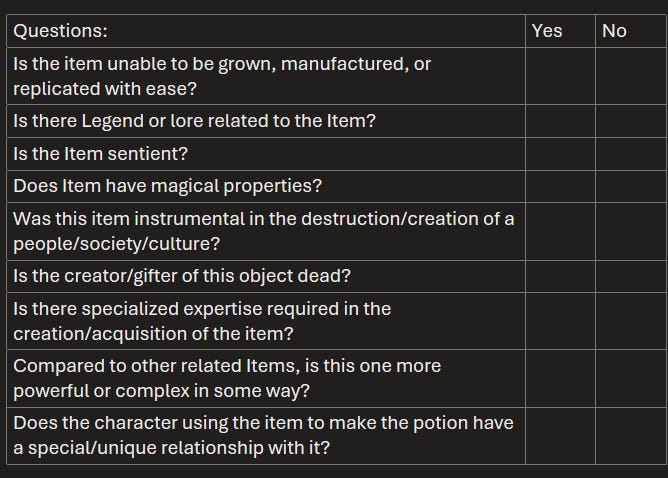
For each question that was answered “Yes”, give the ingredient a +1 stat, to a maximum value of +5. While multiple specialized ingredients may be used, the maximum value gained from all combined ingredients to make the potion should be capped at and/or never exceed +5.
Any ingredients used in the crafting of a potion should be rendered inert or completely unusable. This establishes stakes for the players to risk.
Using Potions
I have sat at many a table and seen many games and one consistent point of contention is, “how do I drink a potion during combat.” While this seems like an easy solution, “just use your action to drink the potion”, that can often defeat the purpose as you just responded to getting hit by healing up so the opponent can hit you again. The best way to fix this, I have found, is to use the NADDPOD (Not Another D&D Podcast) approach.
The NADDPOD Approach
a) If you use a bonus action to drink a health potion that could heal 1d8+4, roll the dice on the health potion to see what you get
b) If you use a full action to drink a health potion that could heal 1d8+4, you would receive the maximum amount of health from the potion (In this case 12HP).
Essentially, all potion rolls are maxed out, when using a full action to consume them.
Oops!
In the event that something stops a character from drinking a potion partway through its consumption, one of two conditions can apply.
- In the event that the majority of the potion is remaining: The remainder of the potion is labeled as a failed potion (see failed potions); The character then rolls on the failed potion table to see If they gain the effects of a failed potion. (A benevolent DM may also allow a character to roll the constitution check with disadvantage to gain the full effects of the potion in this situation)
- In the event that the majority of the potion has been drunk by one character: The character then rolls a dc 15 constitution check to see if they gain the effects of the potion, on a fail the player rolls on the failed potions table, and the remaining potion is rendered inert.
This, however, should be used sparingly or only for narrative value, as frequent use might discourage players from using potions at all.
Crafting Stats and Rarity (In the Thick of it)
Now to get into the actual Potion Making. When making potions a general rule of thumb is that it should on average take 2 hours per potion (Max 2 per long rest), this gives the players something to do during their downtime and an inability to mass create potions during battle. If aided by a potion of haste or any other exterior support, I will place the burden on the DM to decide If it allows the player to produce the potion faster.
Skills
As with most things in D&D 5e, there are multiple ways to achieve most goals. In the realm of crafting, D&D has a few stats that seem to have been made perfect for this goal. Nature, Arcana, Medicine, and even Performance or Sleight of hand may be used in crafting potions.
Arcana
This method would require lots of study and arcane symbols and is typically done in sterile environments. Often, Monks, Wizards or Alchemists will use this skill to make potions that would allow them to study longer or enhance their spells.
Nature
Think of this method as the dirtiest method, using natural ingredients and even involving one’s own body in the potion isn’t uncommon. This method is often done outdoors by Rangers and Druids, often in order to make potions of transformation or to communicate with nature.
Medicine
While a healing potion is not the only thing one could create with this skill, any other type of spell is often used to prevent upcoming wounds or damage. Many Clerics, paladins, and fighters, gain a small amount of knowledge in potion crafting, for it could mean the difference between surviving the night or meeting their god.
Sleight of Hand
Potion making, while typically seen as arcane, when done this way is viewed as a science. Using the right ingredients in the right way, chanting the right words at the exact time, may allow a rogue or sorcerer the ability to disappear into the night
Performance
This skill is often used by Bards and Warlocks and is the most ritualistic. Though they use the same skill, the methods of potion creation could not be more different between classes, with the Bard using arts and song, the Warlock would use Chants and blood.
The only limit is the imagination and leniency of your DM. However, there are bonuses you can gain through Proficiencies as well, i.e. an Herbalism or Alchemy kit, which should give you a +2 to all your alchemy rolls.
You may pick the method of creating the potion, but may only use one, for instance, using the laboratory bonus would restrict you from using the herbalism kit bonus.
Thus, I present to you, The Station Chart:
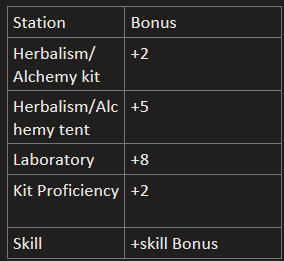
Altogether if you are a rogue using an alchemy kit that you are proficient in and you have a +3 bonus to nature, you will receive a total of +7 to your roll, this is not even including potentially powerful ingredients you may carry on you person.
However, how do you know the DC of the potion you are trying to create? Well, I want to offer two options for Potion making below.
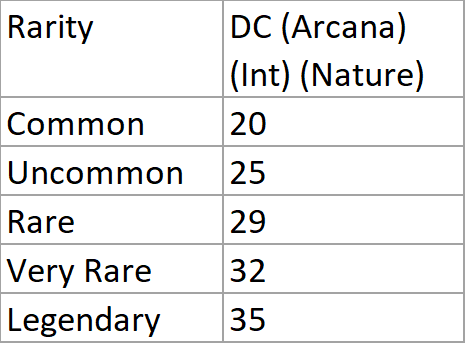
First, The Alchemy Almanac:
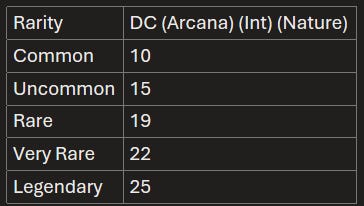
I really enjoyed the Idea from the “Alchemy Almanac” by heavyarms.com which sets the difficulty of as following:
Second, The Chaotic and Super Complicated:
While the almanac is excellent, I find it is too easy for players to create potions that should require mastery in the skillsets. So, I offer a change on the traditional. Firstly, I have increased the value of all potions by 10 doing this allows the ingredient and proficiency bonuses to not overpower the system. Secondly, every time a player rolls to create a potion (regardless of success), the DC of that potions rarity permanently decreases by 1 for that player. If the DC ever reaches 10, the DC for the next Rarity is decreased by 5.
For instance, Bolga has rolled to make a common potion 10 times, making the DC for common potions now 10, this now decreases the cost to make uncommon potions from 25 to 20.
In theory Bolga could try to roll to make a legendary potion, with the ingredients and proficiencies she has, or she could take the VERY long way and make a bunch of smaller potions in order to reduce the DC.
Potion Design: Rarity
When designing a potion, try to think of how it will be utilized in cannon. Where the rarity of a potion in one world, will not be 1:1 in another. If you are playing in a world with very little magic, maybe a call of Cthulhu style system, potions may be rarer than in the world of fantasy and dragons. I typically think of potion making as one would cooking.
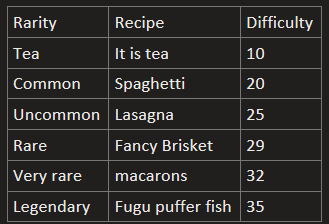
In this version if a player attempted to make a legendry potion Every day and failed it would still take 30 hours minimum to get the Stat to 20 and 60 hours of failed attempts to get it down to a 10. And while messing up spaghetti would just leave the player with some undercooked noodles, messing up Fugu could leave a player dead.
** If a project fails because of invalid spell ingredients, it does not bring the DC down, only if the correct ingredients are able to be used, then the Potion can be crafted. For instance, “A thing made with love and A thing of life and faith.” It could be argued that any living thing was made with love, so using a bug may suffice, (However a DM may give you a negative penalty for it), but the “thing of life and faith” is much different. Holy water is faithful and could help sustain life, thus I think it could be used, but not every player carries holy water in their back pocket. So, if a player attempted to use a jug of water that they themselves blessed, the potion may just fail because the water is in no way “a thing of Faith”, and therefore the player would not even be able to attempt a roll to create the potion.
Failed Potions.
No matter which system you like, or which rules you use, when a player fails at creating a potion, said player may feal like all the work and time they have spent has amounted to nothing; to prevent this phenomenon I recommend adding a “failed potion” to the players. When the potion is drunk, the creature that drank it rolls a D12 on the “Failed Potion Table”. This way, the D12 can finally benefit from the touch of another, and the player has at least something to gain from it. Remember, as with most things in this guide, this table is adjustable, so you may homebrew your own wacky things in it in whatever way you see fit.
Roll
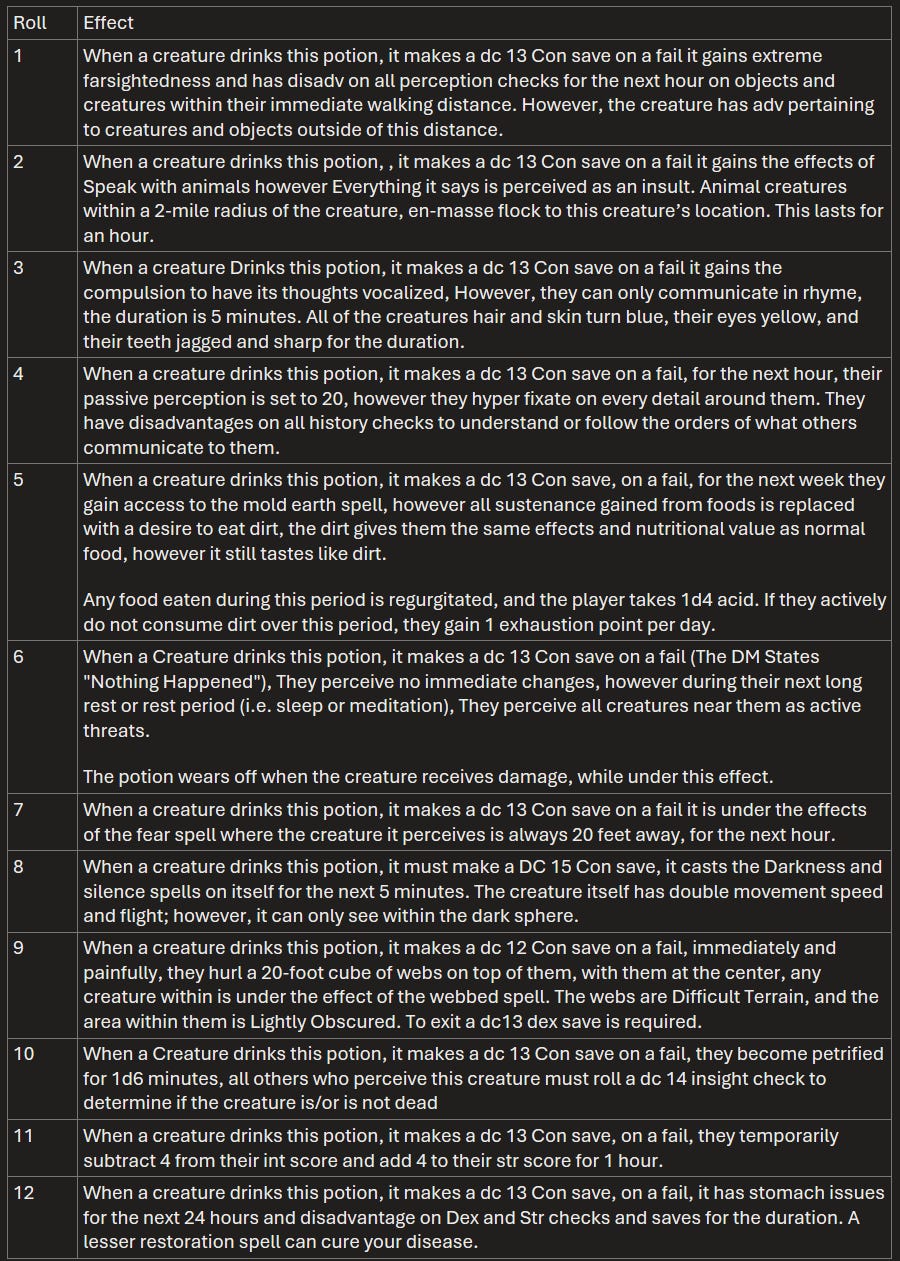
It is important to reiterate that the effects of the “Failed Potion” are not applied until after the potion is drunk. If a Creature consumes a “Failed Potion” unknowingly (i.e. A player drugged them) it must make a dc 10 insight check or the study action to detect if it knows the potion has been consumed (i.e. tasting it).
Potion Design
As DM’s the weight of creativity falls to us when determining what is and what isn’t in our worlds.
1. Consider the setting: Potions should be used narratively and therefore a DM can allow or disallow any potions or types of potions of their choice; this freedom could allow for better storytelling and set work.
a. Example: Curse of Strahd, maybe a potion that functions as a bridge between the alter self and turn undead potion would work,
b. Example: Lord of the Rings, you might want to avoid potions of haste or flight as they may nullify the journey.
2. Keep an Eye on your system: It is important to note the unspoken rules surrounding the potions that already exist in the cannon and systems you utilize, no two spells will work perfectly for any system.
a. Example: Blades in the Dark, this system has a wonderful system for casting spells and crafting items by focusing on their narrative uses as well as their mechanical,
b. Example: Dungeons and Dragons Fifth Edition, this system tends to lean entirely on the mechanical side. So, when designing potions for 5e, it is important to try and stick to the mechanics.
Example scenario: designing a potion using 5e at the behest of a player.
Let’s say a player wants a defensive potion similar to the shield spell, to protect them during battle. The Constraints of our potion making system make it so that a player can not take a potion as a reaction, so the dm has a few options:
a. Potion of shielding: When a creature drinks this potion, they gain the ability to cast the Shield spell once per day as a reaction. (This sucks)
Why this sucks: The mechanics around the spell work, however the spell is lacking any flavor. It also gives any nonmagic user the ability to become a powerful spellcaster with just the right amount of gold.
b. The Frost Wardens Elixir: When drunk the creature gains 1d4+1 temporary HP for 1 hour. When hit with a melee attack while the creature still has temporary HP, the attacker receives 1d4+1 cold damage. (This is neat)
Why this works: With this potion, there is a clear mystery within the name of the spell as to who the “frost warden” may be, it is also based on the Armor of Agathys spell with not being nearly as powerful, as to set a difference in the abilities of spell casters and non-spellcasters.
Overall, DMs should not just create copies of spells to make into potions but flavoring them to fit their setting, it is important to balance the functionality and the goal of the potion in its design.
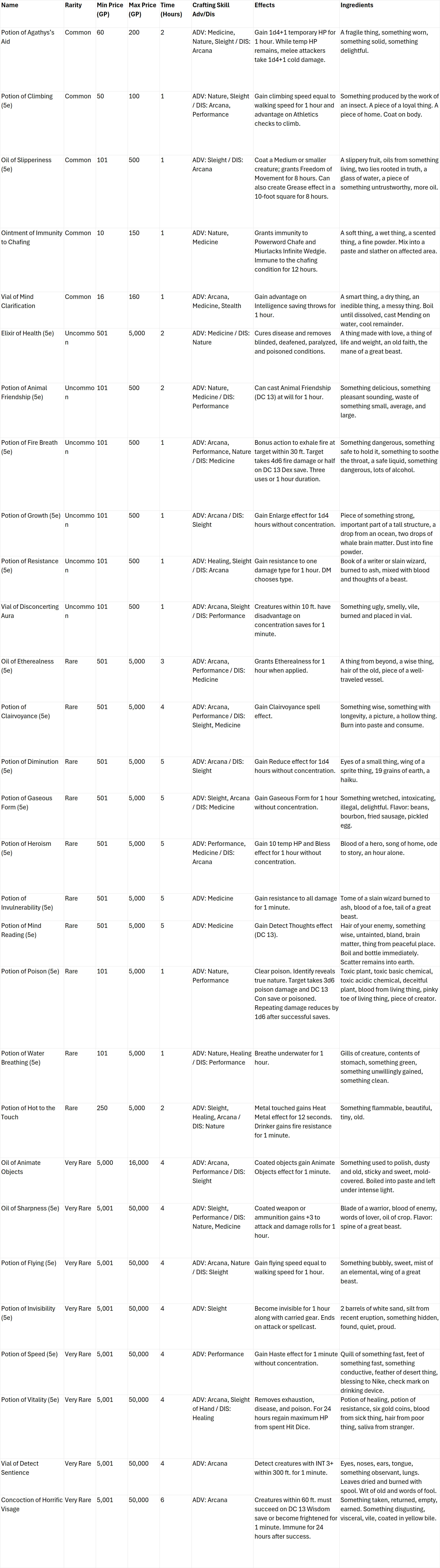
Some example potions: